
002: Creativity and Expression
Playfulness, expression, art and media - the mix of human and AI hallucinations - feature or a bug?


Editor Note: This blog post is an AI-generated summary of an in-person conversation held on 2023-07-05 in San Francisco facilitated by Ian Eisenberg
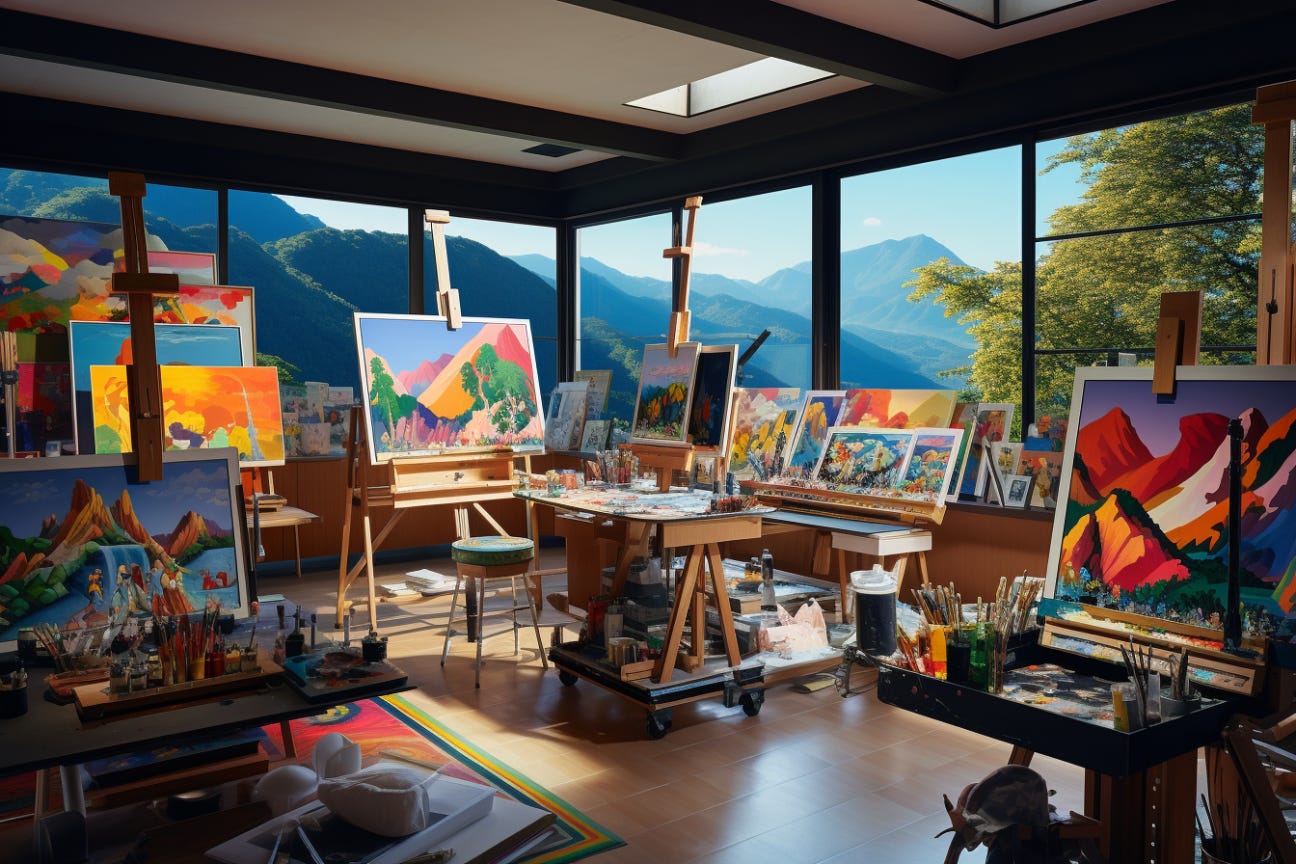
Creativity, often romanticized as the spontaneous generation of novel artifacts, is in truth a multifaceted process deeply embedded in human consciousness and experience. It transcends mere creation of artifacts, involving imagination, playfulness, and an ability to shift perspectives based on a rich tapestry of life experiences. This view of creativity aligns with the thoughts of Ken Robinson, who emphasized creativity as an ongoing process rather than a singular event.
The essence of creativity lies in the conscious intent behind it. A lightning bolt pattern, for example, is a natural phenomenon, but capturing it photographically is a creative act, signifying the crucial role of consciousness in creativity. This distinction echoes the ideas of Arthur Koestler in "The Act of Creation," where he delineates between accidental happenings and intentional acts of creation.
Creativity often thrives in a state of flow, where ideas emerge seemingly unintended. This state, as described by Mihaly Csikszentmihalyi, involves relinquishing control, yet it also requires a foundation of technique and understanding. The creative process is not just about the end product, or artifact, but a complex interplay of perception, intentionality, and the novel combination of ideas. While traditionally attributed to human minds, the question arises whether these components necessitate a human mind or if they could manifest in different forms, such as artificial intelligence.
This brings us to the debate on AI and creativity. AI systems, like ChatGPT, have shown potential in assisting human creativity by offering ideas and editing support. However, they lack the human consciousness and intent crucial for creativity. The question of whether AI can exhibit creativity and consciousness akin to humans remains contentious. While some believe AI could develop its own form of creativity and interiority, others argue that without human experience, something essential is missing.
AI's involvement in creativity also leads to concerns about homogenization of taste and mass-produced culture, as seen in industries like film. Yet, AI also democratizes access to creative tools, allowing more people to explore and develop their creative skills rapidly, a phenomenon previously limited to those with lifetimes of practice.
However, the infrastructure and systems of our society might be shaping us more into consumers than creators. This observation brings to mind the writings of Theodor Adorno and Max Horkheimer on the culture industry, where they argue that mass-produced culture stifles individual creativity and leads to passive consumption.
The value and worth of creativity and art are equally complex and subjective. They are influenced by a myriad of factors including history, context, intentionality, and impact. The emergence of AI in creative fields forces a reexamination of these definitions, challenging traditional notions of worth and attribution.
Attribution and recognition play a significant role in the creative process, reflecting cultural constructs around individual achievement. In some societies, individual recognition is discouraged, reflecting a more communal approach to creativity. Yet, for many, getting credit for original work is crucial for their creative identity, highlighting a tension between individual ego and collaborative creation.
Ultimately, finding meaning in creativity is a personal endeavor, with no singular path that suits everyone. Humans construct narratives to make sense of the world and their experiences, a concept explored by Viktor Frankl in his work on meaning and existentialism.
In conclusion, creativity is a complex, multifaceted process deeply intertwined with human consciousness, experience, and societal structures. It is not just about producing artifacts but involves a rich interplay of imagination, playfulness, and perspective shifts. As we navigate the evolving landscape of creativity, especially with the advent of AI, it's essential to keep exploring these themes, as discussed by thinkers like Ken Robinson, Arthur Koestler, Mihaly Csikszentmihalyi, Theodor Adorno, Max Horkheimer, and Viktor Frankl.
Notes from the conversation
- Creativity requires some level of intentionality and consciousness to transform something into art, rather than just creating random artifacts. The photographers' intent makes the lightning bolt photo art.
- Creativity can emerge unintentionally through play, imagination and relinquishing control rather than just focused effort. There's value in letting go sometimes.
- Creativity manifests in many forms - work processes, physical artifacts, finding patterns. It's not limited to typical art forms.
- There are open questions around whether AI systems can be truly creative given their lack of human consciousness and life experience that shapes human creativity.
- Human creativity may increase value more than physical effort or time spent. Quickly created art can be expensive while lifelong creative effort may not. There are other factors.
- Consciousness and the ability to declare something as art is key to human creativity. AI lacks this layer of intentionality and interpretation of its own output.
- Creativity requires some skill and effort built up over time through experience. It's more than random output. But randomness and surprise are part of it too.
- The notion of what constitutes "creativity" is shifting as AI capabilities advance. Creativity may no longer be defined by intentionality or consciousness, but rather by the ability to generate novel and valuable outputs.
- There is a difference between simply creating new outputs versus expressing an "interiority" through those outputs. True creativity may require some form of individual perspective or experience being conveyed.
- The artifacts or outputs themselves take on more significance than the creative process. The story, history, and context for how an artifact was created becoming a currency.
- Rules provide a framework for creativity. Mastering structure and techniques allows rules to be broken in more impactful ways. Randomness alone does not necessarily achieve great creative heights.
- There are parallels between AI in art and AI in domains like chess. The process can feel sterile without the human element, even if the outputs have technical quality.
- Definitions of consciousness and creativity are intertwined and slippery. As capabilities advance, the definitions themselves may need to adapt rather than be bounded by current conceptions.
- There is a tension between technical, scientific creativity versus more expressive, subjective human creativity. Breakthroughs in one domain do not necessarily translate neatly to the other.
- The definition and value of art is shifting as AI generates content that seems creative but lacks human context or intent. This raises questions around what makes something meaningful.
- Memes specifically rely on human cultural context and interpretation to have impact. It's unclear if AI can automate this successfully.
- There are open questions around legal rights and copyright of AI generated content - how much human involvement is required for something to be protected, and who holds rights.
- As technology progresses, the law struggles to keep up in determining what level of human effort or transformation is substantial enough to claim creative ownership. There is ambiguity that needs to be resolved.
- Simply inputting a prompt may not reach the threshold of human creativity required for legal protections. Additional manipulation may be needed, but laws can lag behind technology advancements.
- Creativity and intuition come from experience that AI systems can help provide rapidly, allowing faster skill development. However, over-reliance on AI risks homogenizing creative output if we don't maintain our own creative taste and judgment.
- Democratizing acknowledgement of contributions from all people, not just "great men", could better credit innovations built on billions of ideas over generations. Some form of digital acknowledgment could help move society forward collectively.
- Pursuing ideas carries a human toll seen in entrepreneur bankruptcies and unrecognized scientific contributors that uphold transformative innovations. We tend to focus only on eventual success stories.
- The monetary incentive structure of markets alone likely cannot lead to human flourishing without additional coordination through regulations, standards or soft norms. A solely money-driven system has not achieved an optimistic, beneficial innovation trajectory.
- Recognition and copyright structures may primarily serve enterprises rather than individual creators. Alternative decentralized and open structures could better reward creators.
- People have different motivations - some want to freely share while others need financial reward. Systems could be designed to accommodate both.
- Ideas build incrementally on other ideas over time. Attribution and compensation structures could better reflect this continuous history.
- Cultural constructs shape perspectives on ownership and recognition. Radically different systems are conceivable.
- There are privileges inherent in not needing recognition or rewards. Systems should consider creators with financial needs.
- Societal structures like status games seem deeply rooted in human psychology. Future systems would likely incorporate new forms of status attribution rather than eliminate it.
- Recognition provides feedback on whether you're on the right path, though self-confidence is easier if you've had early validation.
- Those with privilege can underestimate the importance of recognition, while those who've struggled want it more.
- Status systems allow coordination of group goals through incentives, though spiritual values can also drive people.
- AI governance is struggling to keep pace with technological change; flexibility may work better than rigid regulation.
- Solving joint contribution and ownership issues could enable an abundance mindset and capture the Web 3 ideology.
- There's concern that mass production of culture via AI could lead to lack of creativity like with formulaic Marvel movies.
- Infrastructure steering people toward consumption over creativity may or may not reflect their true preferences.
- Value and meaning are deeply personal - what gives one person meaning may not translate to others. We each construct our own narratives and paths.
- Creativity and innovation often arise from individual drive and idealism, not societal structures. Though structures enable impact at scale, the spark tends to be individual.
- Standing out creatively requires effort and perseverance, often in isolation. It can be arduous with little external validation.
- Subverting norms and expectations takes courage. Society rewards productivity, but fulfillment may lie in charting one's own path.
- Status symbols like PhDs don't always align to impact or financial success. The journey itself must be intrinsically rewarding.
Questions
- Does creativity require consciousness and intention, or can it emerge unintentionally?
- Can AI systems be truly creative without consciousness and lived experience?
- Does human involvement alone make something artistic, even if accidentally created?
- Is editing and refining work a creative act in itself?
- How do we define and measure creative value?
- What specific components need to be present in a system or process before we consider it "creative"?
- Can a non-conscious, non-intentional system create things that are worthwhile and express some kind of interiority?
- How do we define and measure the "interiority" of a system?
- Does the system need to have a human-like consciousness and intentionality to be considered creative?
- What is the distinction between simply creating novel outputs versus expressing something meaningful?
- How do we define if a creative output reflects some inner essence or experience of its creator, whether human or machine?
- If logo creation becomes automated, does that change the definition of art?
- Can the contextual relevance and placement of memes be automated?
- If AI creates impact without human intent, is that still worthwhile?
- What gives things worth?
- Does community meaning make something worthwhile, even if it's automated?
- How much human effort is required for legal copyright protections?
- Are prompts copyrightable?
- How will the law adapt to advancing AI capabilities?
- How can we structure copyright and intellectual property systems to balance incentives for innovation while still allowing public access and downstream creativity?
- What governance systems and incentive structures will best promote human flourishing alongside advanced AI?
- Should we recognize and credit all contributors to innovation, not just the "great man" who gets fame and fortune?
- How can we ensure AI enhances rather than homogenizes human creativity and taste?
- Instead of money and fame, what other rewards could incentivize innovation?
- How can we balance openness and privacy as we track ideas across people and systems?
- If AI systems can do everything in the future, will humans lose meaning and purpose aside from playing status games?
- If current creative professionals enable the next wave of AI creativity, should they retain status or financial compensation for their contribution?
- Do humans inherently need public recognition or is that culturally constructed and subject to change?
- Could scientists find meaning improving humanity with psychedelics without sacrificing lives?
- Can people develop inherent self-worth and confidence through struggle, or is it primarily a privilege of status?
- If recognition serves partly as useful feedback on one's talents and direction, how does class privilege distort that signal?
- Is the pain and drive underlying recognition seeking necessary and inevitable to coordinate collective action and achievement?
- Can alternative value systems beyond money and status successfully coordinate society while enabling human flourishing?
- How quickly can governance and regulation adapt to emerging technologies like AI?
- Is the commercial production of culture leading to dangerous homogenization where people just passively consume rather than actively create?
- Do infrastructure and social norms cultivate an excessive focus on consumption over creativity and self-actualization?
- What specific social structures are unlikely to go away, and why does drive and motivation necessarily lead to progress?
- How can we build systems to authentically trace contributions to collaborative endeavors and properly recognize all contributors?
- Is the existence of status tokens the primary motivation for pursuing certain difficult career paths that provide less financial stability?
- Why do some people choose to subvert societal expectations of productivity rather than seeking traditional measures of success?
 | A guest post by
|